Trusted AI in finance won't come from another white paper.
TrustX for Finance is a non-profit-led, community-driven program for financial institutions, technical partners, and researchers building the practical assurance layer for AI governance in financial services — with assets tested against real-world deployments, starting with agentic finance.
WHY IT MATTERS
Agents are entering finance faster than governance practice.
AI in financial services is crossing a line: from models that predict to agents that act — initiating payments, negotiating with other agents, executing decisions inside regulated workflows.
What’s missing isn’t principles — the industry has plenty. What’s missing is the working machinery between principles and production: the instruments, evidence, and shared infrastructure that turn a policy into something a supervisor can inspect. Today, every institution is building that machinery alone.
The Autonomous Finance Working Group is how that shared machinery gets built. A controlled testing environment where institutions validate autonomous AI systems before production deployment and generate the audit-ready evidence governance actually requires — not self-attestation, but observed behavior under real conditions, including adversarial ones. Classification, runtime enforcement, behavioral drift detection, and survivability testing are conducted independently, with institutions retaining full ownership of their agent logic and testing artifacts. The Open Agent Registry and is where policy becomes proof.
Agentic AI is transactional
When an agent can move money, governance failures become financial events, not policy footnotes.
Evidence is the new baseline
"We have a responsible AI policy" no longer answers a supervisory question.
Isolation is expensive
Parallel, private reinvention of the same controls multiplies cost and divergence.
Spotlight
Spotlight:
RAI Open Agent Registry (ROAR)
-
→
What it is An open governance core — not a SaaS app. ROAR provides a public schema, a 12-dimension agent risk model, published scoring logic, baseline mappings to major standards, starter policy and control templates, and downloadable classification worksheets..
-
→
Why it's useful It gives teams a common, reusable way to classify AI systems by what they can actually do — including their autonomy, authority, persistence, system reach, and data exposure — rather than relying on vendor labels or broad use-case descriptions.
-
→
How it educates Public reference entries show how the schema, scoring logic, and mappings work on representative AI systems, so organizations can see what a complete, defensible classification looks like before applying TrustX internally.
-
→
How it connects to TrustX ROAR is the public registry layer inside TrustX. It helps translate agent behavior into risk tiers, controls, standards mappings, and evidence that can be used by members, working groups, and internal governance teams.
INAUGRAL WORKIGN GROUP
Autonomous Commerce & Banking Working Group
Founding members including U.S. Bank and NatWest Group are contributing real-world use-cases, expertise and practical examples. The group is open to financial institutions and technical partners wanting to contribute to the future of AI governance in finance.

“As consumers and businesses begin using AI systems that can act on their behalf, financial institutions need a common assurance framework. Preparing for the inevitable expansion of agentic AI use cases is critical. Classification, controls, and independent verification will be essential to deploying these systems safely and responsibly.”

“As financial services organizations begin deploying agentic AI, we must move quickly but responsibly — assessing the risks of this powerful new technology, embedding robust controls before deployment, and proving those controls hold in production.”
What the working group delivers
Five working assets
Unlike framework bodies that publish guidance, TrustX for Finance produces evidence artifacts institutions can use in production. The group’s sandbox is built from five connected components:
TrustX risk classification
The 12-dimension model for classifying AI systems by autonomy, authority, persistence, and data exposure — with a transparent roll-up to risk tier.
Responsible AI policies & controls
Policy and control libraries mapped to NIST AI RMF, ISO/IEC 42001, the EU AI Act, and SR 11-7 — proportionate to risk and autonomy.
TrustX Open AI Registry
The openly licensed governance core: public schema, scoring logic, agent blueprints, and reference entries. Spotlight below.
x-LOD report generation
Line-of-defense-ready governance and assurance reporting — from sample templates to organization-specific board and regulator packages.
Guidebooks, research & templates
The Build, Buy & Protect AI guidebooks, research papers, and ready-to-use implementation templates.
Built on globally recognized frameworks.
NIST AI RMF
The US federal AI risk management framework. Baseline for most enterprise governance programs.
EU AI Act
Binding EU regulation. If you operate in or sell to Europe, this is already in scope.
ISO 42001
The international standard for AI management systems. Increasingly expected by enterprise procurement.
SR 26-2
The Federal Reserve's model risk guidance. Applies to any model that drives decisions at regulated financial institutions.
OWASP
Security risks specific to AI and LLM applications. Covers prompt injection, data poisoning, and related attack vectors.
MITRE ATLAS
Adversarial threat modeling for AI systems. Maps real-world attack techniques to defensive controls.
who should join
Three audiences, three paths in..
The group’s sandbox is built from five connected components — each with an honest output, each something a member can pick up and use.
Financial institutions
You're accountable for AI that acts inside regulated workflows — and for the evidence behind it.
Assessment instruments and controls to adapt, sandbox validation before production, private peer benchmarking.
Bring live deployment cases, pressure-test draft controls, and (at charter) vote on what becomes standard.
Technical partners
Your products are how governance becomes real — better one open schema than forty bespoke checklists.
The schema to map to, interoperability validation in the testbed, recognized standing with regulated buyers.
Contribute reference implementations, surface what isn't implementable yet, run your tooling in sandbox cycles.
General & corporate members
You deploy AI, advise those who do, or shape policy around it — and the standards are forming now.
Published assets as they land, visibility into where financial-sector governance is heading, registry worked examples.
Reference access, community sessions, and a channel to feed your perspective into the workstreams.
Five assets. Three tiers. One open core.
The public tier is a commitment, not a teaser — the schema, scoring logic, and baseline mappings stay openly licensed. Membership unlocks depth: sector-calibrated tools, peer benchmarking, and working group access for institutions shaping what comes next.
| Value category |
Public Community
Free
|
RAI Member
Institute Membership
|
Working Group Member
TrustX for Finance
|
|---|---|---|---|
| 01Risk classification | Introductory methodology, sample classifications, educational examples | Full classification framework, assessment tools, benchmark reports | Finance-calibrated classifications, emerging risk factors, working-group scoring refinements |
| 02Policies & controls | Sample controls, public guidance documents | Full policy & control libraries; mappings to NIST, ISO, EU AI Act, SR 11-7 | Finance, banking & payments controls; delegated-authority frameworks; industry-approved patterns |
| 03Open AI Registry | Browse public entries, sample blueprints, public risk profiles | Full registry access, downloadable blueprints, policy mappings, assessment templates | Early access to new blueprints, peer-shared implementations, industry benchmark data |
| 04x-LOD reports | Sample reports and report templates | Generate organization-specific reports and governance artifacts | Finance-specific x-LOD reporting, regulatory mappings, board & regulator packages |
| 05Guidebooks & research | Select guidebooks, public research papers, introductory templates | Full Build, Buy & Protect library and implementation resources | Finance-specific guidebooks, co-authored research, advanced templates, emerging-risk briefings |
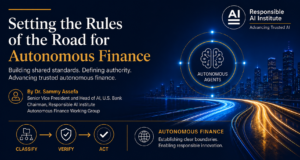
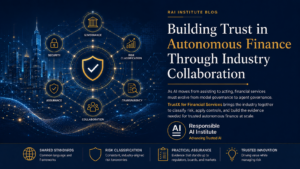
The Autonomous Finance Working Group is a bank-led group for senior AI and risk leaders at financial institutions that are actively deploying or evaluating agentic AI — systems that can initiate payments, execute workflows, and act with delegated authority. It is not a research forum. Members collaborate on real production use cases and contribute to shared governance standards that the whole sector can use.
Five working assets: a shared risk classification system for autonomous AI, a policy and controls library calibrated to financial services, the TrustX Open AI Registry, audit-ready governance reports, and implementation guidebooks. The Public Edition of the registry — including the classification schema, baseline control mappings, and reference blueprints — is free and openly available.
Existing frameworks were designed for systems that recommend. TrustX for Finance is designed for systems that act. It operationalises NIST AI RMF, ISO/IEC 42001, and SR 26-2 — not replacing those obligations, but extending them to cover delegated authority, runtime enforcement, and the evidence standard required when an AI system can initiate a financial transaction.
Dr. Paul Dongha, Head of Responsible AI & AI Strategy at NatWest Group, chairs the TrustX for Finance initiative.
Dr. Samuel Assefa, SVP & Head of AI Innovation at U.S. Bank, chairs the inaugural Autonomous Finance Working Group.
Both founding members are contributing live deployment use cases — governance specifications grounded in systems already being built.
Financial institutions can join as working group members — with a seat at monthly sessions, access to draft standards, and a pathway to TrustX Autonomous Finance verification. Technology and infrastructure providers can participate as Working Group Partners. Published standards and public events are available to all at no cost. RAI Institute is onboarding founding members from June 2026.
The work has started. The table has seats.
Join the institutions and partners building the operational layer for trusted AI in finance and learn more about what the group is already building.