Financial services has always been an industry built on trust. Every payment, credit decision, trade, insurance claim, fraud alert, and customer interaction depends on systems that must be reliable, explainable, secure, and accountable. For decades, banks and financial institutions have invested heavily in risk management, model governance, compliance, cybersecurity, audit, and controls. That foundation is a real strength.
But the next phase of AI is testing that foundation in new ways.
AI is moving from assisting to acting. Earlier generations of AI helped classify transactions, detect fraud, score risk, summarize documents, and support human decisions. Agentic AI systems go further. They can pursue goals, use tools, access systems, coordinate workflows, adapt over time, and in some cases recommend, route, update, approve, or execute actions.
That shift changes the risk equation.
When an AI system only provides an answer, governance focuses on whether the answer is accurate, fair, explainable, and compliant. When an AI agent can take action, governance must also ask: What is this system allowed to do? What authority has been delegated to it? What systems can it reach? What data can it access? Can its actions be reversed? Who is accountable when it goes wrong? What evidence proves it is operating within approved boundaries?
These are not questions any one institution should have to solve alone.
Autonomous finance will require industry collaboration because the risks are shared, the systems are interconnected, and the expectations of regulators, customers, boards, and markets will converge. If every institution defines agent risk differently, measures autonomy differently, and applies controls differently, the result will be fragmentation, confusion, and slower adoption. Worse, it could erode trust just as the technology begins to scale.
That is why the Responsible AI Institute is launching TrustX for Financial Services: an RAI-convened, bank-led initiative designed to help financial-services leaders build a shared approach to trusted autonomous finance.
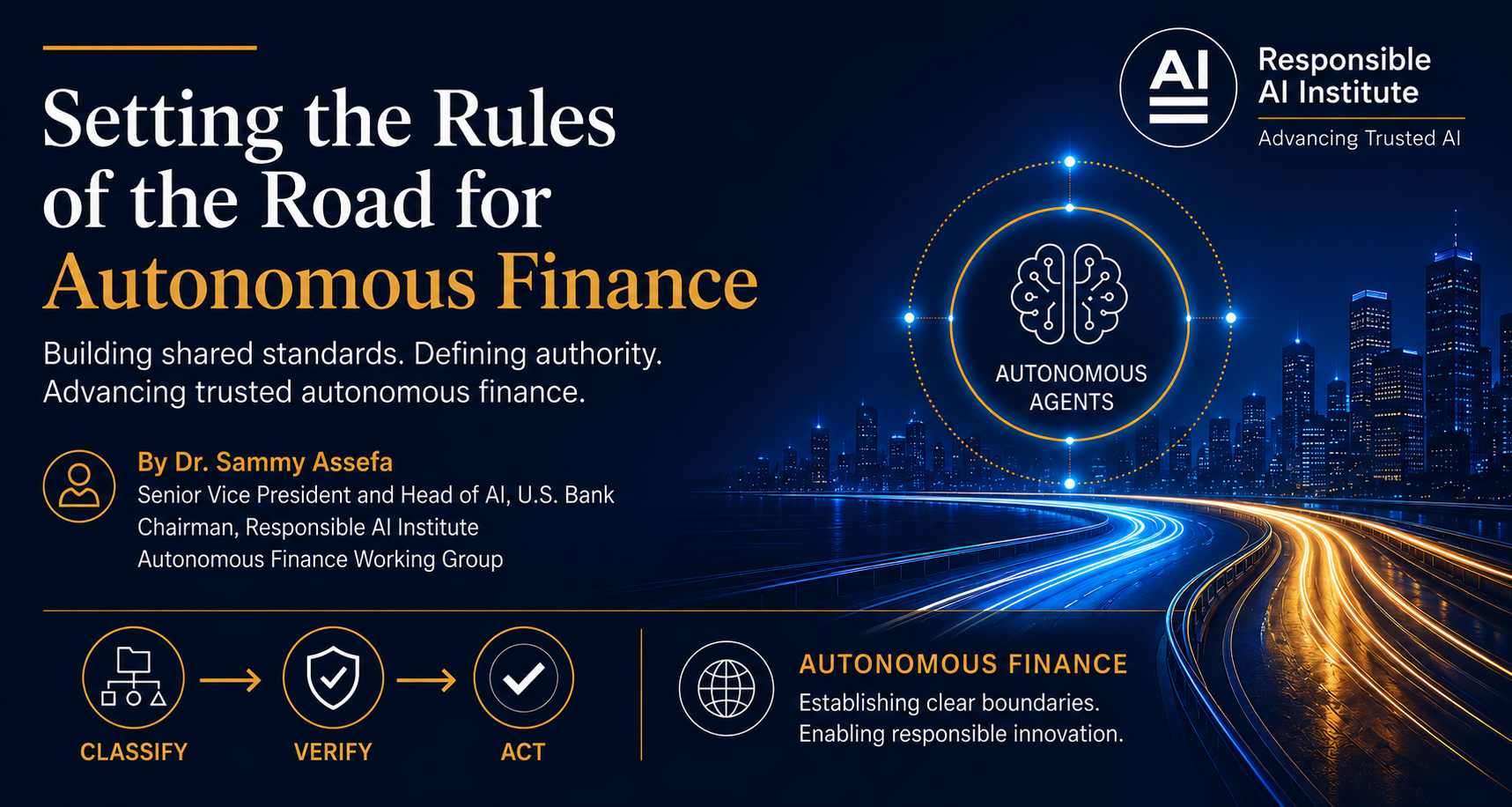
The initiative is chaired by Dr. Paul Dongha, Head of Responsible AI & AI Strategy at NatWest Group. The inaugural Autonomous Finance Working Group is chaired by Dr. Samuel Assefa, SVP & Head of AI Innovation at U.S. Bank — two of the most thoughtful practitioners in this space.
The goal is not to slow innovation. It is to make responsible innovation easier to deploy.
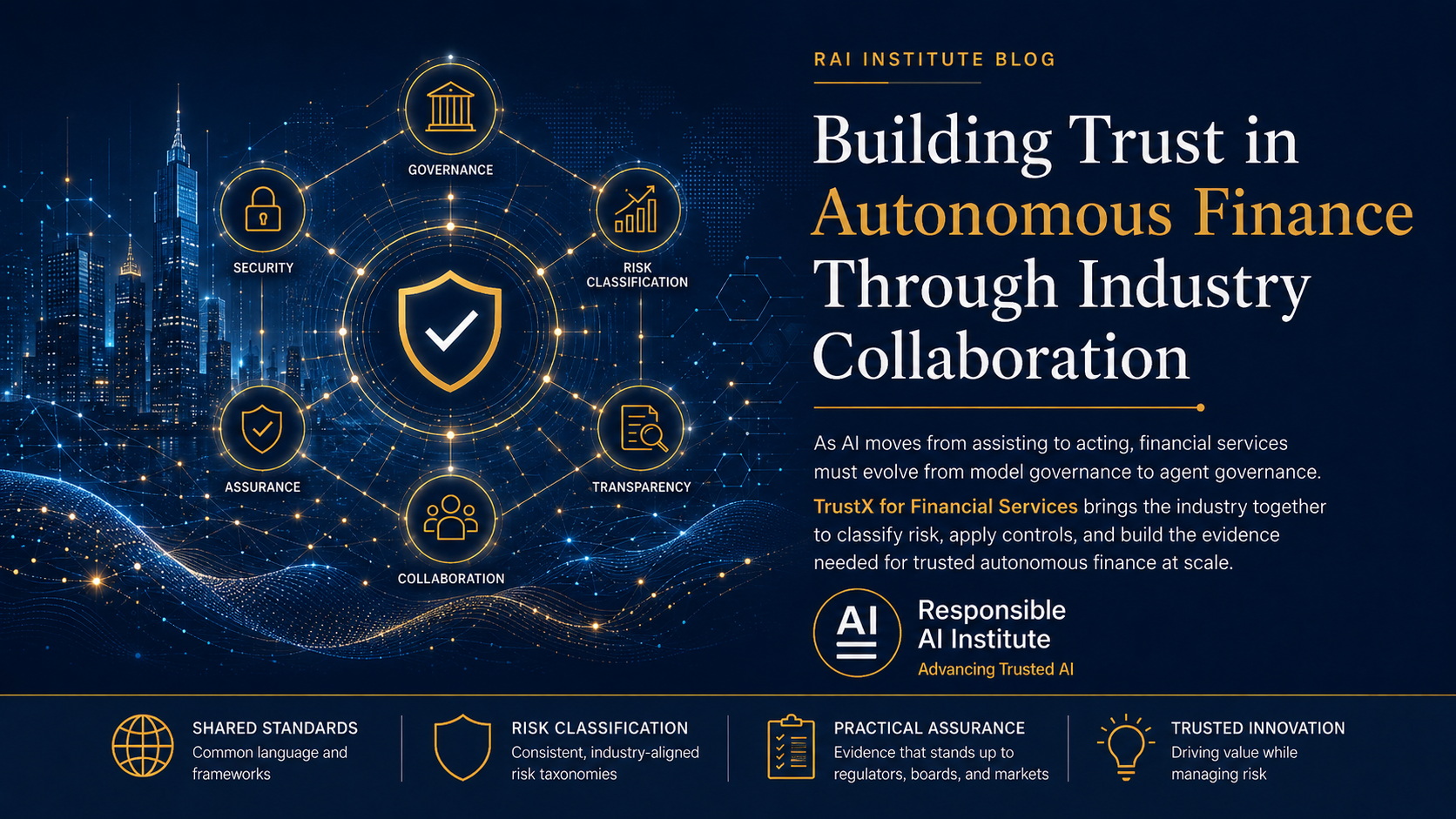
TrustX for Financial Services brings together banks, financial institutions, researchers, technology providers, and other ecosystem participants in a neutral, non-profit-led space. The purpose is to establish a common language and practical framework for classifying agentic AI risk, mapping that risk to controls, and producing credible evidence that systems are operating within defined boundaries.
At the center of this effort is a simple idea: you cannot control what you cannot classify.
Agentic AI risk does not come from the model alone. It comes from behavior. A system that summarizes a policy document is very different from a system that updates a customer record, approves a claim, moves money, executes a trade, or coordinates across multiple enterprise systems. TrustX focuses on the characteristics that matter: autonomy, authority, persistence, reach, reversibility, data sensitivity, and control.
Through the TrustX Sandbox and the RAI Open Agent Registry (ROAR), participating organizations will be able to explore public examples, compare agent risk patterns, review sample reports, and learn how different types of financial-services agents can be classified and governed. The sandbox is not a runtime monitoring product. It is a collaborative learning and assurance environment: a place where examples become structured, comparable, and reusable.
This matters because the industry needs more than broad principles. It needs practical tools that help teams move from discussion to implementation.
For public users, ROAR can help build literacy around how agent risks are identified and classified. For RAI members, it can become a pattern for internal registries, evidence packs, policy mapping, and governance workflows. For TrustX Working Group members, it can support deeper collaboration: sector-specific use cases, peer learning, benchmark patterns, x-LOD reporting examples, and emerging control expectations.
The non-profit role is important. Trust in autonomous finance cannot be created by any single vendor, platform, bank, or regulator acting alone. It requires a neutral space where institutions can learn together, compare patterns, and shape common expectations before systems are widely deployed in high-stakes workflows.
RAI’s role is to convene that space, bring an independent responsible AI lens, and help translate shared learning into practical assurance artifacts that institutions can use with boards, auditors, regulators, and customers.
The future of financial services will include AI agents. That now seems clear. The open question is whether those agents will be deployed through fragmented self-attestation, or through shared standards, independent assurance, and evidence that can stand up to scrutiny.
Autonomous finance can create enormous value: faster service, better risk detection, more efficient operations, more personalized products, and new forms of financial access. But value compounds only when trust keeps pace with capability.
That is the work ahead.
By bringing the industry together through TrustX for Financial Services, RAI is helping create a practical path from experimentation to trusted deployment: learn the risks, explore the sandbox, compare the registry, apply controls, and build the evidence required for responsible autonomous finance.
The next era of finance will not be defined only by how powerful AI agents become. It will be defined by whether we built the infrastructure to prove they are worthy of trust.