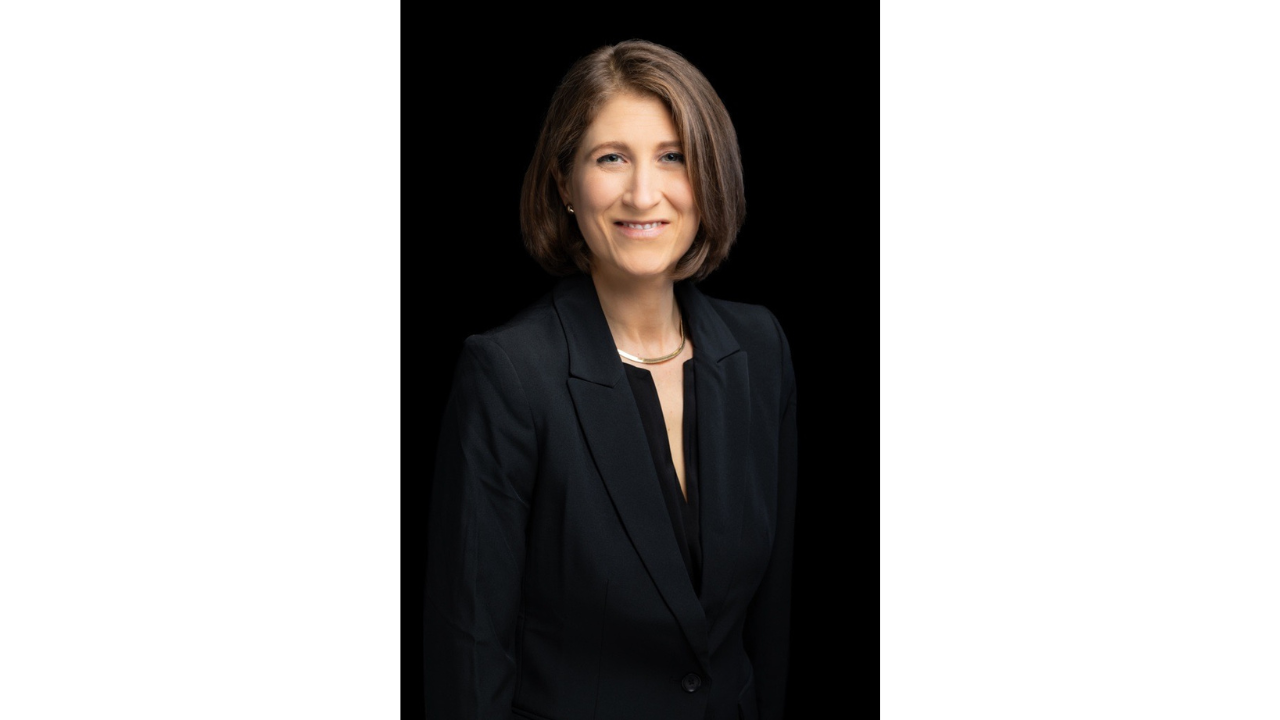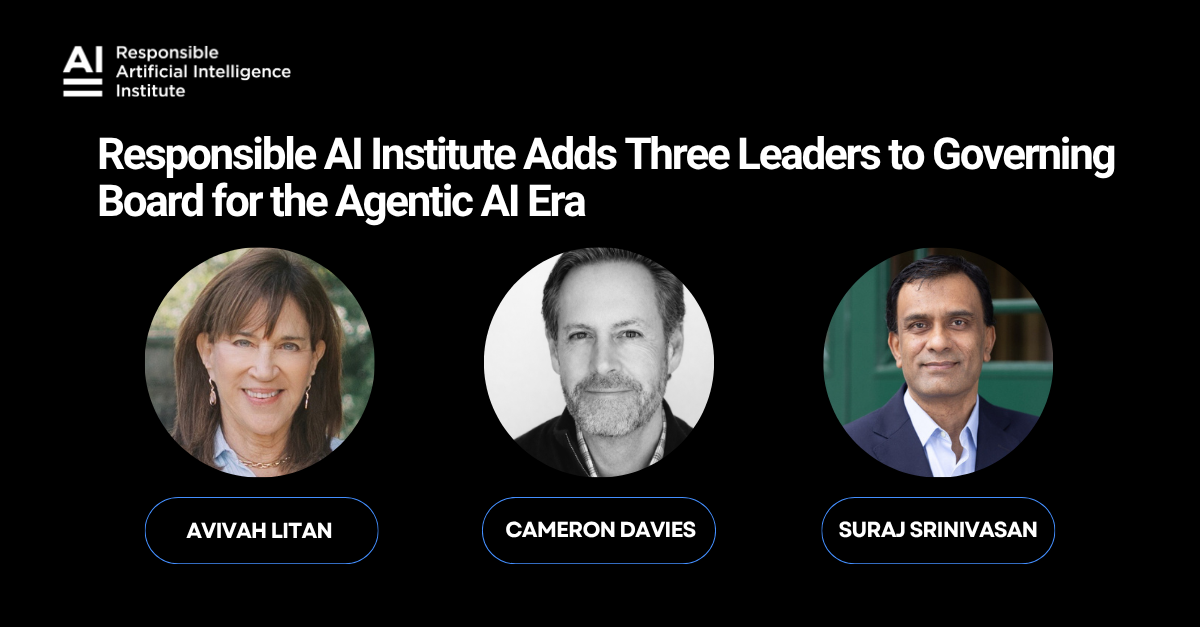
Avivah Litan, Cameron Davies and Harvard Business School Professor Suraj Srinivasan bring expertise spanning AI risk and assurance, enterprise-scale AI deployment, and board accountability
AUSTIN, TEXAS — September 15, 2026 — The Responsible AI Institute (RAI) today announced the appointment of Avivah Litan, Cameron Davies and Professor Suraj Srinivasan to its Governing Board, strengthening the organization’s leadership across AI risk and security, enterprise-scale deployment, and corporate accountability.
The appointments come as artificial intelligence crosses an important threshold. Enterprises are moving beyond AI systems that primarily generate content and recommendations toward systems that can plan, use tools, make decisions and increasingly take actions across business environments.
That shift is changing the question from “Can we use AI?” to “How do we deploy it at scale with confidence, control and accountability?”
“AI is crossing a threshold from systems that primarily advise people to systems that increasingly act on their behalf,” said Manoj Saxena, Founder and Executive Chairman of the Responsible AI Institute.
“That makes responsible AI a board-level and operating-model issue, not simply a technology or compliance function. Avivah, Cameron and Suraj bring three perspectives that are essential to what comes next: understanding emerging AI risk, deploying AI responsibly at global scale, and strengthening board accountability as organizations entrust AI with greater autonomy and authority.”
“Their addition strengthens RAI’s ability to help organizations move from responsible AI principles to controls, and from controls to credible proof,” Saxena added.
AVIVAH LITAN: AI RISK, SECURITY AND ASSURANCE
Avivah Litan brings decades of experience across cybersecurity, fraud, identity, emerging technology and AI risk. During more than two decades at Gartner Research as Vice President and Distinguished Analyst, she helped shape the firm’s work on AI trust, risk and security alongside longstanding research in fraud prevention, identity and emerging technologies.
Her appointment comes as the AI risk landscape expands beyond traditional cybersecurity. Increasingly autonomous systems introduce new questions around delegated authority, permissions, system boundaries and whether organizations can demonstrate that AI remains within defined limits as it operates.
Litan brings that risk and security perspective to RAI’s work on independent AI assurance, technical controls and verifiable trust.
“Agentic AI changes the risk equation because these systems do more than generate content. They can make decisions and take actions across enterprise environments. Organizations need practical ways to define what these systems are allowed to do, establish enforceable boundaries and independently verify that those controls are working.”
CAMERON DAVIES: OPERATIONALIZING RESPONSIBLE AI AT ENTERPRISE SCALE
Cameron J. Davies, Chief Data & AI Officer at Yum! Brands, leads the company’s global AI, data, analytics and decision science organization supporting its worldwide restaurant business across KFC, Taco Bell and The Habit Burger Grill.
His perspective reflects a challenge facing enterprises across industries: the difficulty is no longer simply identifying AI use cases. It is creating the architecture, operating model and controls required to deploy AI consistently and responsibly across large, complex organizations.
“Most organizations aren’t struggling to find AI use cases. They are struggling to create the operating model that allows hundreds or thousands of AI-enabled capabilities to be deployed consistently across the enterprise.”
For Davies, responsible AI and innovation are increasingly inseparable.
“Trust is becoming a strategic advantage. Responsible AI isn’t separate from innovation; it is what allows innovation to scale. The organizations that get this right will be able to move faster because they have the confidence and control to deploy AI broadly.”
Davies brings direct experience translating responsible AI from policy into enterprise architecture, platforms, processes and operating practices.
SURAJ SRINIVASAN: BRINGING AI GOVERNANCE INTO THE BOARDROOM
Professor Suraj Srinivasan is the Philip J. Stomberg Professor of Business Administration at Harvard Business School, where his work spans artificial intelligence, business strategy, corporate governance, risk management, and board of director effectiveness.
His research and teaching examine how emerging AI technologies are changing business performance, organizational decision-making, and executive leadership. His work with directors and senior executives also addresses the evolving responsibilities of boards as companies navigate technological transformation, risk, and accountability.
His appointment strengthens RAI’s ability to address an increasingly important reality: AI oversight is becoming a core responsibility of boards and executive leadership, not only technology teams.
“AI is a strategic and organizational issue, not simply a technology issue. Boards need to understand both the opportunities these systems create and the new forms of risk, authority, and accountability questions they introduce. Our challenge is to give leaders the evidence and frameworks they need to oversee AI with confidence as its role in the enterprise expands.”
RISK. SCALE. ACCOUNTABILITY.
Together, the three appointments strengthen RAI’s Governing Board across three areas that are rapidly converging as AI becomes more autonomous:
- AI Risk & Assurance — understanding emerging risks and establishing credible ways to assess and verify AI systems.
- Enterprise AI at Scale — translating responsible AI from principles into the architecture, operating practices and controls required for large-scale deployment.
- Board Accountability & Strategy — helping directors and senior executives understand how AI changes oversight, decision authority and organizational accountability.
The expanded Board comes as RAI grows its work on the independent assessment and assurance of increasingly autonomous AI systems.
Through initiatives including TrustX, RAI is developing practical approaches to classify AI risk based on factors such as autonomy and authority, establish controls proportional to that risk, and produce credible evidence that executives, boards, customers and regulators can use to evaluate whether AI systems are operating within defined boundaries.
RAI is also applying this work through sector-focused initiatives in areas including financial services and healthcare, bringing together enterprises, researchers and practitioners to develop approaches grounded in real-world AI deployment.
“AI is moving from assisting to acting, and that changes what responsible deployment requires,” Saxena said. “The next generation of responsible AI has to connect technology, risk, enterprise operations and board accountability. These appointments significantly strengthen RAI’s ability to convene those perspectives and help organizations navigate what comes next.”
The new board members will help guide RAI as it expands its research, industry collaborations, member programs and independent assurance work across the next generation of enterprise AI.
Media Contact:
news@responsible.ai